
Small Details, Big Difference: Coffee Table Styling Ideas
Your coffee table says more about your home than you might think. It's the one surface everyone sees the moment they walk in. Most people style it as an afterthought. But a few well-chosen pieces, placed with intention, can turn it into a real focal point — one that sets the tone for the whole room. You don't need a lot. You just need to know what works.
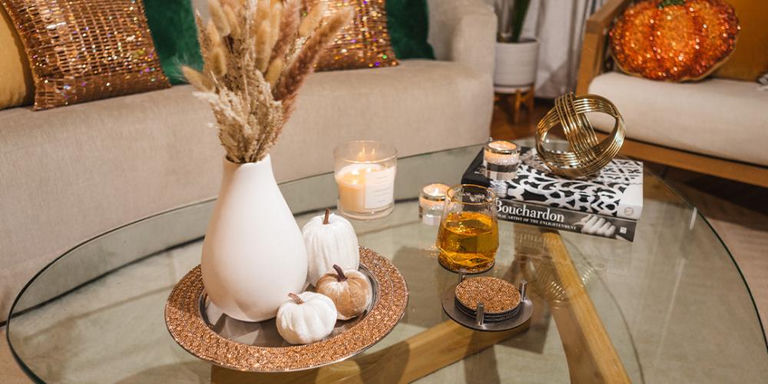
THE DESIGN PRINCIPLES BEHIND A WELL-STYLED COFFEE TABLE
Great coffee table styling isn't random. It follows a few visual rules that designers use every time. Once you understand them, they're easy to apply yourself.
The most important principle is layered height. A flat surface full of same-sized objects looks cluttered, even when it's tidy. Instead, aim for at least three different heights. Something low like a tray or coasters. Something mid-height like a candle or small stack of books. Something taller like a vase or sculptural piece. This creates visual movement and gives the eye a natural path to follow.
THE RULE OF THREE
In our experience, the rule of three is the most reliable styling principle. Group objects in odd numbers. Three items almost always looks more natural than two or four. Try a candle, a small tray, and a decorative object. Simple, balanced, and finished.
The second principle is contrast in texture. A glass vase next to a rough linen book cover next to a smooth metallic coaster creates visual interest without adding color or clutter. You can keep a neutral palette and still make the surface feel rich and layered.
Third, leave breathing room. A coffee table should never be completely covered. Empty space isn't wasted. It's what makes the styled pieces stand out. Aim to keep about 30% of the surface clear.
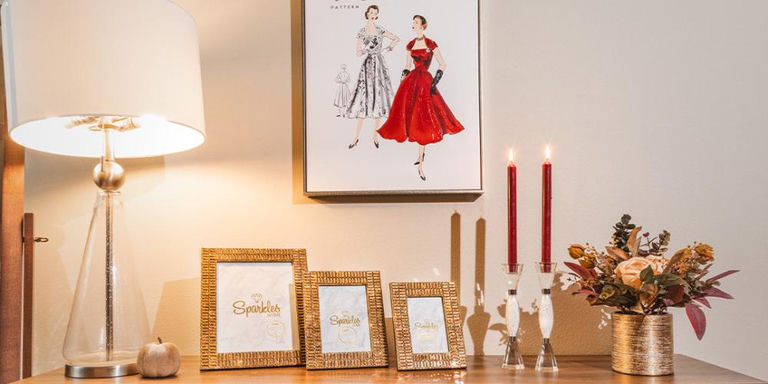
HOW TO BUILD YOUR COFFEE TABLE VIGNETTE, STEP BY STEP
A "vignette" is just a small, intentional grouping of objects. Here's a simple process that works for almost any coffee table style.
START WITH A BASE:
- Place a tray to anchor the grouping
- Choose one in a contrasting material
- Keep it proportional to your table size
- Everything inside the tray reads as one unit
BUILD UP FROM THERE:
Add your tallest item first. A vase, candlestick, or small sculptural piece works well. Then layer in mid-height objects. Finish with flat elements like coasters or a small book. Step back and edit. Remove anything that feels crowded or out of place.
The base does a lot of the work. It creates a visual boundary that makes a grouping look intentional rather than scattered. A tray is the obvious choice, but a decorative charger plate works just as well. The Madison Avenue Charger Plate is crafted from stainless steel and glass rhinestones. It doubles as a styled surface all on its own. Set a vase on top and the whole grouping instantly feels more polished. It comes in gold, red, and silver, so it coordinates easily with your existing metal tones. For a larger arrangement, the Regent Tray gives you more room to work with. It's filled with faceted crystals on a mirrored glass base, which adds a reflective layer that makes everything on top look more refined.
COASTERS AS DÉCOR: RHINESTONE AND CRYSTAL COASTER STYLING IDEAS
Coasters are one of the most overlooked styling opportunities on a coffee table. They're practical, yes. But a beautiful set does double duty as an accessory, even when no one's using them.
The key is treating them as part of the arrangement, not an afterthought. Stack them neatly in their holder and place them slightly off-center within your tray or grouping. A rhinestone or crystal coaster set catches light from every angle, especially in a room with natural light or warm lamp glow. A single set can change the mood of the whole surface.
The right coaster set can pull a whole table together. It's small, but it reads like jewelry for your living room.
The Madison Avenue Coaster Set is crafted from stainless steel and glass rhinestones, and it comes with a matching holder. It's available in gold, red, and silver, so you can match your existing metal tones or use it as a deliberate accent. The set stores neatly in its holder, so it looks just as good when stacked as when in use.
QUICK STYLING CHECKLIST:
- Use a tray to group and anchor your items
- Include at least three different heights
- Mix textures: glass, metal, linen, wood
- Leave 30% of the surface clear
- Style coasters as an accessory, not just a utility
- Edit down. When in doubt, remove one thing
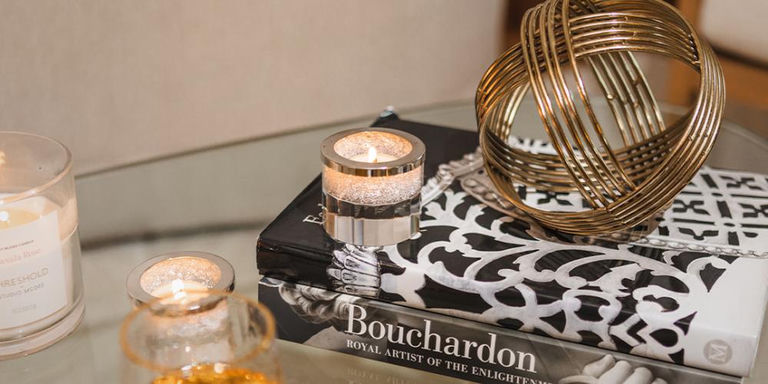
ADDING CANDLELIGHT AND CRYSTAL: COFFEE TABLE AMBIANCE TIPS
Nothing changes the feel of a room faster than candlelight. On a coffee table, a single candle or a small cluster adds warmth, texture, and a sense of occasion. It makes a room feel alive, even on a quiet Tuesday evening.
When placing candles on a coffee table, keep them within your central grouping rather than at the edges. The light should feel intimate, not like it's reaching across the table. A raised candleholder works well here. The height creates presence without bulk, and the elevated base lets the glow spread more evenly.
FOR A SOFTER, ROMANTIC LOOK:
Try these combinations:
- Crystal candleholder with a tealight
- Soft linen books as a base layer
- A bud vase with a single stem
- Warm-toned tray in champagne or gold
FOR A BOLDER, GLAM LOOK:
Try these combinations:
- Rhinestone coaster set in a mirrored tray
- Tall crystal-filled candlestick
- A vase with silver or charcoal rhinestones
- Metallic accents in a single consistent tone
The Vetrina Raised Candleholder is a good example of how a single piece can do a lot. It's filled with sparkling crystals, and the raised base lets the warm glow filter through from below. Place it at the center of your tray and watch how the light plays off everything around it. The coasters, the tray surface, even the table itself all catch that glow.
If you want a vase in the mix, the Vetrina Vase comes in champagne, charcoal, gold, rose, and silver. It works beautifully with or without florals. Filled only with glass rhinestones, it catches light on its own and doesn't need anything added to look complete.
The goal with any coffee table is to make it feel considered. Not over-styled, not bare. When each piece has a purpose and the arrangement has rhythm, the whole room benefits. Start with a tray, layer in objects at varying heights, add one piece that catches the light, then step back and edit until the balance feels right.
Comments
Leave a Comment